If you’re looking for Cognitive Behavioral Therapy in Richmond, VA, our therapists are here to help.
At Aspect Counseling and Psychiatry, we have professional, licensed therapists with years of experience in Cognitive Behavioral Therapy (CBT).
- We’re available for in-person CBT therapy in Richmond, VA, as well as telehealth sessions throughout Virginia
- We have over a dozen therapists to choose from to find the perfect fit
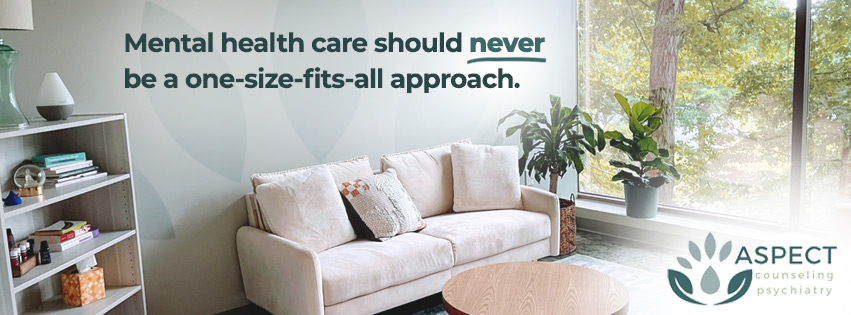
- We never take a one-size-fits-all approach; every client is unique
If you’re still wondering whether Cognitive Behavioral Therapy is right for you, let’s briefly discuss what it is, its many benefits, and the types of issues for which we recommend it.
What Is Cognitive Behavioral Therapy?
Cognitive Behavioral Therapy (CBT) is one of the most widely used and research-backed forms of talk therapy. At its core, CBT focuses on the connection between your thoughts, emotions, and behaviors.
1. Identifying Negative Thoughts
Recognizing harmful or unrealistic beliefs that affect emotions and behaviors
2. Challenging These Thoughts
Evaluating the evidence for and against these thoughts to determine if they are accurate or helpful
3. Changing Behaviors
Developing new, healthier behaviors and coping strategies that align with more realistic and balanced thoughts
Unlike some forms of therapy that take years to see results, CBT is usually structured and goal-oriented. Many people notice meaningful improvements in just a few weeks.
So if you’re looking for CBT therapists in Richmond, VA, our licensed professionals can guide you through this process step by step.
The Benefits of Cognitive Behavioral Therapy
CBT is effective for a wide range of mental health concerns. Some of the key benefits include:
- Improved coping skills for stress, anxiety, and depression
- Reduced symptoms of conditions such as OCD, PTSD, and bipolar disorder
- Practical strategies that you can apply immediately in everyday situations
- Short-term and long-term results, with many clients experiencing lasting change
- Flexible treatment options, including in-person and online sessions
By working with a skilled CBT therapist, you’ll learn how to break free from negative cycles and create healthier patterns to take with you throughout the rest of your life.
How Our CBT Therapists Can Help
Our CBT therapists in Richmond are licensed, experienced, and compassionate practitioners who specialize in helping clients with a variety of concerns. Here’s what you can expect with Aspect Counseling and Psychiatry:
- Personalized treatment plans to meet your specific needs and goals
- Evidence-based techniques proven to deliver results
- A supportive and nonjudgmental environment where you can be yourself and talk openly
- Tools and exercises you can practice at home to reinforce the progress you’re making during your sessions
- An administrative staff that holds your hand through the complicated world of insurance, and is upfront about pricing
Whether you are new to therapy or have tried other approaches before, our CBT therapists will meet you where you are and guide you toward meaningful change.
CBT Therapists in Richmond, VA
Aspect Counseling and Psychiatry employs over a dozen therapists, most of whom have extensive experience with CBT. Here’s a list of all our CBT therapists.
Click on a therapist to learn more about them & schedule your first session.

Abby Mason
LPC

Amber Zarger
LCSW

Brooke Lawler
PsyD, LCP

Carla Crews
LCSW

Carlie Powers
LMFT, CST, CAADC

Gabby Scalzo
PhD, LCP

Hunter Worsham
LPC

Jaime Goldberg
RIC

Josh Barefoot
LPC

Kellye Baker
PMHNP-BC, DNP

Kristina Gilbert
LPC

Lauren Powell
LPC

Laurie Manns
LPC, CSAC

Lindsey Bowers
LPC

Mikeyda Travers
LPC

Molly Iracane
LCSW

Paula Connolly
LCSW

Rachel Salinas
LPC

Robyn D’Reaux-Rodgers
LCSW

Sarah Charbonneau
LCSW

Shenika Whitaker-Carlos
LCSW, CSOTP

Taliaferro Smith
PsyD, LCP
Different Types of Cognitive Behavioral Therapy
There are several different types of Cognitive Behavioral Therapy that vary based on the techniques and approaches used. These types share the core principle of CBT—focusing on changing negative thought patterns and behaviors—but each has its own emphasis or method.
Between all of our therapists, we have someone who practices all of the following types of CBT at our office, as well as virtually for those who aren’t in the Richmond area.
Traditional CBT
Focus
The classic type of CBT involves identifying and challenging negative thoughts and beliefs, replacing them with more realistic and balanced ones. It combines cognitive restructuring with behavior modification techniques.
Techniques
Thought records, cognitive restructuring, behavioral experiments, exposure exercises, and problem-solving.
Dialectical Behavior Therapy (DBT)
Focus
Developed by Marsha Linehan, DBT is a type of CBT specifically designed to treat individuals with borderline personality disorder (BPD), but it has since been adapted for other conditions. It focuses on teaching skills to manage emotions, tolerate distress, improve interpersonal relationships, and practice mindfulness.
Techniques
Mindfulness, distress tolerance, emotional regulation, and interpersonal effectiveness skills.
Acceptance and Commitment Therapy (ACT)
Focus
ACT combines aspects of CBT with mindfulness strategies. It emphasizes accepting thoughts and feelings without judgment, living in alignment with personal values, and committing to behaviors that promote well-being, even in the presence of difficult emotions.
Techniques
Cognitive defusion (detaching from thoughts), mindfulness, acceptance, and values-based action.
Mindfulness-Based Cognitive Therapy (MBCT)
Focus
MBCT blends traditional CBT techniques with mindfulness practices. It was developed to prevent the relapse of depression, particularly for those who have experienced multiple episodes. The goal is to increase awareness of thoughts and feelings in the present moment and to prevent individuals from ruminating on negative thoughts.
Techniques
Mindfulness meditation, body scanning, and cognitive restructuring to interrupt negative thinking patterns.
Behavioral Activation (BA)
Focus
Behavioral Activation is a more focused form of CBT primarily used to treat depression. It helps individuals identify and increase engagement in activities that bring a sense of accomplishment or pleasure, breaking the cycle of avoidance and inactivity that contributes to depression.
Techniques
Activity scheduling, identifying reinforcing behaviors, and reinforcing positive activities.
Exposure Therapy
Focus
Exposure therapy is a type of CBT that specifically targets anxiety, phobias, and post-traumatic stress. It involves gradual exposure to feared situations or objects in a controlled manner to reduce avoidance behavior and desensitize the person to anxiety-triggering stimuli.
Techniques
Gradual exposure, systematic desensitization, and virtual reality exposure (in some cases).
Compassion-Focused Therapy (CFT)
Focus
CFT combines CBT with principles of mindfulness and compassion, aiming to reduce self-criticism and increase self-compassion. It is particularly useful for people struggling with shame, guilt, and low self-esteem.
Techniques
Compassionate imagery, self-compassion exercises, and mindfulness practices.
Treatable CBT Conditions
Cognitive Behavioral Therapy is effective for a wide range of mental health challenges, including:
- Anxiety disorders
- Depression
- Postpartum depression
- Obsessive-compulsive disorder (OCD)
- Bipolar disorder
- Eating disorders
- Post-traumatic stress disorder (PTSD)
- Substance use disorders
- Stress management and burnout
CBT is highly adaptable. It can be tailored to your unique situation, whether you’re struggling with day-to-day stress or a more complex issue.
For specifics on certain conditions, let’s take a look at some common conditions and how CBT is used to treat them.
CBT & Postpartum Depression
Postpartum depression can feel overwhelming, but CBT can offer effective strategies to manage your symptoms. Our therapists can help new parents…
- challenge negative self-talk
- reduce feelings of guilt
- develop healthier coping mechanisms
By focusing on both thought patterns and practical daily strategies, CBT provides a roadmap for new moms to cope during such a vulnerable time in their lives.
The following CBT therapists at our office love working with clients navigating postpartum depression:
CBT & Bipolar Disorder
For those living with bipolar disorder, CBT can be an important part of treatment, alongside medication. Our CBT therapists work with clients to…
- recognize early warning signs of mood shifts
- develop strategies to manage stress and triggers
- challenge extreme or harmful thought patterns
- strengthen routines that support stability
By learning these skills, many people with bipolar disorder have gained greater control and confidence in managing their condition.
Many of our therapists are equipped to work with clients with bipolar disorder, including:
- Kellye Baker, PMHNP-BC
- Brooke Lawler, PsyD, LCP
- Lauren Powell, LPC
- Hunter Worsham, LPC
- Leigh Carter, PMHNP-BC
- Joshua Barefoot, LPC
- Gabby Scalzo, PhD, LCP
- Jonathan Yoder, PMHNP-BC
- Rachel Salinas, LPC
- Kristina Gilbert, LPC
- Laurie Manns, LPC, CSAC
- Robyn D’Reaux-Rodgers, LCSW
- Shenika Whitaker-Carlos, LCSW, CSOTP
- Elizabeth Markey, PMHNP-BC, MSN, CNM, PMH-C
- Carla Crews, LCSW
- Abby Mason, LPC
- Allison Ernest, PMHNP-BC
- Amber Zarger, LCSW
- Jennifer Peele, FNP-BC, PMHNP, APRN
- Ryan Ernest, PMHNP-BC
- Mikeyda Travers, LPC
- Molly Iracane, LCSW
- Paula Connolly, LCSW
- Carlie Powers, LMFT, CST, CAADC
CBT & OCD
Obsessive-compulsive disorder often creates a cycle of intrusive thoughts and compulsive behaviors. CBT—especially when combined with Exposure and Response Prevention (ERP)—is one of the most effective treatments for OCD.
During therapy, clients gradually face feared thoughts or situations in a safe and controlled way while resisting compulsive behaviors. Over time, this reduces the anxiety and urgency associated with many OCD triggers.
More than a dozen therapists at our Richmond office have experience working with OCD.
View OCD TherapistsCBT & Eating Disorders
Eating disorders often involve deeply ingrained thought patterns about food, body image, and self-worth. CBT helps address these harmful beliefs and replaces them with healthier perspectives. Clients learn to…
- challenge distorted thinking related to food and body image
- develop healthier eating habits and coping strategies
- build self-esteem that isn’t tied to weight or appearance
Our therapists provide compassionate, evidence-based support for individuals struggling with anorexia, bulimia, binge-eating disorder, and other disordered eating patterns.
View Eating Disorder TherapistsWhat to Expect During a CBT Session
A typical CBT session is structured, collaborative, and focused on your goals. Here’s a step-by-step guide on what to expect when you walk into our Richmond office:
1. Office Check-In
Upon arriving, you’ll check in with our front desk staff. They’ll let the therapist know you are here, and confirm if any of your information needs updating.
2. Therapist Check-In
Your therapist will ask how you’ve been feeling and review any homework or exercises from the previous session.
3. Identify Challenges
Together with your therapist, you’ll explore recent thoughts, feelings, and behaviors that may be causing you distress.
4. Learn Strategies
Your therapist will go over some practical tools you can use to better manage your challenges. These might include thought records, behavioral experiments, and relaxation techniques.
5. Practice Skills
You’ll try out these strategies during the session, and your therapist might assign some homework for you to practice when you get home.
6. Evaluate Progress
Each session builds on the previous one, helping you track progress toward your goals.
CBT is collaborative—you and your therapist work together as a team.
The Basics of Cognitive Behavioral Therapy
You might find these answers helpful if you’re just getting started and want to learn more about CBT therapy at our office in Richmond.
Many people attend 12-20 sessions, though the exact number depends on your unique goals and progress.
Yes. Our office accepts many forms of insurance, including medicare. Check our insurance page for a complete list of insurance providers.
Absolutely. We offer telehealth sessions for clients in Richmond and all across Virginia.
Yes, CBT is widely used with children and adolescents to help with anxiety, depression, and behavioral concerns.
If you struggle with negative thought patterns, anxiety, depression, or overwhelming stress, CBT could be a helpful and effective option. Feel free to contact our office so we can help you decide what type of therapy is best for you.
Our Therapy Office
Our therapy office is located in the heart of West End Richmond, in the Innsbrook business complex—at the crossroads of I-64, I-295, Hwy 288, and West Broad St. We share the Liberty Plaza I building with several law offices, financial services companies, and other Richmond-area businesses, at the corner of Cox Rd. & North Park Dr.
4801 Cox Road, Suite 205
Glen Allen, VA 23060
Directions →

Get Started with Cognitive Behavioral Therapy
If you’re ready to take the first step toward feeling better, our CBT therapists in Richmond, VA are here to help. We’ll work with you to create a personalized plan that fits your needs, your schedule, and your goals.
Contact us today to schedule your first appointment.